







Erode Glaucoma Foundation – MIGS
- Home
- Erode Glaucoma Foundation – MIGS
Micro-Invasive Glaucoma Surgery
MIGS stands for Micro-Invasive Glaucoma Surgery (sometimes called Minimally Invasive Glaucoma Surgery).
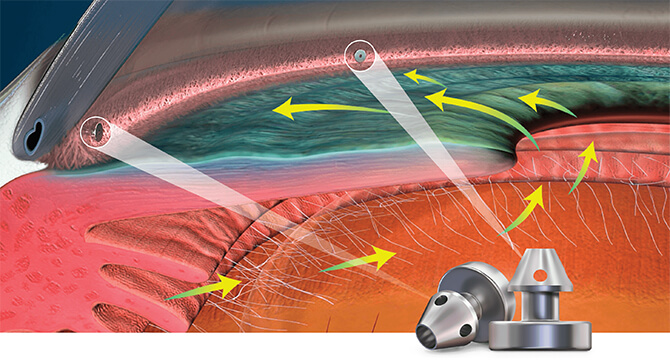
MIGS represents a significant advance in the surgical treatment of glaucoma. These procedures are designed to reduce the pressure inside the eye (intraocular pressure or IOP) with less surgical trauma, faster recovery, and a lower risk of complications compared to traditional glaucoma surgeries like trabeculectomy.
Key Features of MIGS
Minimally Invasive: They involve tiny incisions and microscopic-sized equipment or implants.
Safety Profile: They generally have a very good safety profile and reduced risk of complications (like excessive low eye pressure or bleeding).
Target: They aim to improve the eye’s natural fluid drainage system (aqueous humor outflow) or reduce the production of fluid.
Best for: They are typically used for patients with mild to moderate open-angle glaucoma, and are often performed in conjunction with cataract surgery.
Categories and Examples of MIGS Procedures
MIGS procedures are generally categorized based on how they lower the eye pressure:
| Category | How it Works | Examples of Devices/Procedures |
| Enhancing Trabecular Outflow | Bypassing or removing the blockages in the trabecular meshwork (the eye’s natural drain) to increase fluid flow into Schlemm’s canal. | iStent, Hydrus Microstent (Bypass stents), Kahook Dual Blade Goniotomy, Trabectome (Tissue removal) |
| Increasing Suprachoroidal Outflow | Creating a pathway for fluid to drain into the suprachoroidal space (the space between the retina and the wall of the eye). | Cypass Micro-Stent (though many older suprachoroidal shunts have been withdrawn) |
| Subconjunctival Filtration | Shunting fluid from inside the eye to a space under the conjunctiva (the clear covering on the white of the eye), similar to traditional surgery but with a micro-shunt. | XEN Gel Stent |
| Reducing Aqueous Production | Using a laser to partially ablate the ciliary body, which is responsible for producing the aqueous humor. | Endocyclophotocoagulation (ECP) |
Your ophthalmologist will determine which MIGS procedure, if any, is appropriate for your specific type and stage of glaucoma.
KDB (Kahook Dual Blade Goniotomy)
A modern, blade-based MIGS procedure that removes the diseased drainage tissue to improve natural fluid outflow.
Benefits of KDB
Minimal trauma to surrounding tissue
Long-term IOP control
Quick, painless, and suture-free
Can be combined with cataract surgery
Reduced need for glaucoma drops
iStent Inject / iStent W
One of the world’s smallest medical implants—placed inside the eye’s drainage pathway to improve fluid flow naturally.
Benefits of iStent
Safely lowers eye pressure
Helps reduce dependence on glaucoma medications
Performed during cataract surgery
Excellent safety profile
Fast visual recovery
Minimally Invasive Glaucoma Surgery
Why Choose MIGS?
Minimally invasive
Smaller incisions
Faster healing
Suitable for early-stage glaucoma
Lower risk compared to traditional glaucoma surgeries
Who Can Benefit From MIGS?
MIGS is ideal for patients who:
Have mild to moderate glaucoma
Want to reduce daily eye drop usage
Are undergoing cataract surgery
Need safer, long-term pressure control
Why Choose Vijay Eye Care Hospital for MIGS?
Experienced glaucoma surgeons
Advanced diagnostics & precision planning
Modern MIGS technologies: KDB, iStent, and more
Tailored treatment plans for every patient
Long-term follow-up and glaucoma care support